Nexora originals guide
Tickwright guide: gear puzzle game tips for all 30 levels
Updated · 5 min read
The most useful gear puzzle game tips start with one fact: two gears that mesh always turn opposite ways. In Tickwright that simple rule decides everything. Every clock face must turn the way its arrow asks, any gear you place next to the train joins it at once, and a loop that forces one gear to turn both ways jams the lot.
Tickwright is a calm pegboard puzzle in which Mila the apprentice clockmaker sets brass gears so a wound spring motor drives every clock face the right way round. Below you will learn how to read a level, plan the shortest route and earn three stars. Play Tickwright free and keep this guide open beside it.
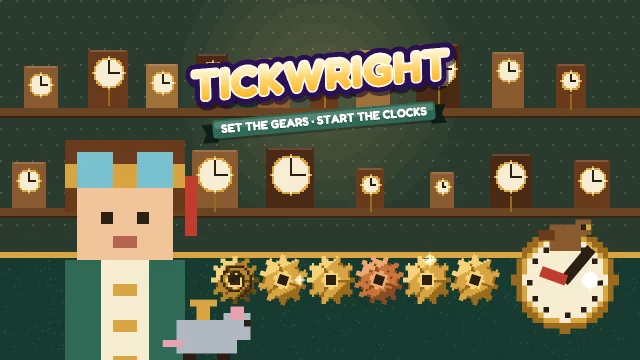
Tickwright
A gear puzzle: set brass gears so the spring makes every clock face turn the right way.
Play Tickwright freeHow gears turn
Turn one gear clockwise and the gear meshing with it turns anticlockwise; the next one along turns clockwise again. In a straight chain, an odd number of gears makes the last gear turn the same way as the first, and an even number makes it turn the opposite way. That is true of any real gear train, and Tickwright follows it exactly.
In Tickwright, gears only mesh with neighbours to the left, right, above or below, never on a diagonal. Any part on a neighbouring peg joins the train straight away, so a gap is the only way to keep two gears apart.
The chessboard rule
Because neighbours always turn opposite ways and gears only touch straight across, the pegboard behaves like a chessboard: picture every peg as a light or dark square. Without bevels, every gear on a light square turns one way and every gear on a dark square turns the other, however you route the train.
This saves a lot of counting. A clock face's direction depends on where it sits, not on how long your route is, so in a level without bevels a face's arrow is already right as long as your train can reach it. Your job is to reach every face with as few pieces as possible, without wasting gears. A copper bevel is the only part that can change which way a face turns.
Plan the shortest route
- Before you place anything, trace with your eye the shortest path from the motor to each face, around the screws that block pegs.
- Check the board's three-star piece count. If your traced route uses more, look for a different way round.
- With two faces, look for one route that passes close to both: gears shared by both branches save pieces.
- Remember that a gear placed beside the train joins it, even by accident. Keep the route one peg clear of parts you do not want to connect.
- Undo and restart are free, so try a route, look at it, and change it.
Jams and how to avoid them
A jam happens when the train would force some part to turn the same way and the opposite way at once. Then the whole train locks and nothing moves. Thanks to the chessboard rule, plain brass and steel gears can never jam each other: any loop of them still agrees. Jams come from bevels. A bevel that closes a loop, or a part that touches the train both beyond a bevel and before it, receives two different orders.
If the train jams, undo your last piece (U, Z or Backspace) and look at the bevel's surroundings. Keep everything after a bevel separate from the rest of the train, with a clear peg between them, and the jam disappears.
Steel gears and two faces in the Tower Clock
Levels 11 to 20, the Tower Clock, bring two faces and fixed steel gears. A steel gear is fixed in place: you cannot move or lift it. But it still meshes with any gear beside it, exactly like a brass one, so it becomes part of your train as soon as you touch it.
Treat steel gears as free pieces already on the board. A route that passes through a steel gear costs one piece less, which helps with the three-star count. Remember that it takes the direction of its square, like any other gear.
Copper bevels in the Cuckoo Hall
Levels 21 to 30, the Cuckoo Hall, add copper bevels and cuckoo birds. A bevel passes the turn on without reversing it, which breaks the chessboard pattern: everything beyond a bevel turns the other way from what its square would suggest.
Use a bevel when a face would otherwise turn the wrong way, or when two faces need the same direction from the same train. Press B or Tab to switch between gear and bevel before placing a piece. Because a bevel changes directions downstream, check every face again after you add one.
Stars and score
| What you do | Points |
|---|---|
| Get the clock going | 300 |
| Each spare piece you did not use | 60 |
| Each star earned | 100 |
Stars come from using the fewest pieces, so a lean route pays twice: more stars and more spare pieces. The 30 levels open one by one, from The Bench (levels 1 to 10, one or two faces) through the Tower Clock to the Cuckoo Hall. If you like this kind of planning, try more puzzle games, or the 2048 corner strategy for a puzzle of a very different kind.
How to solve a Tickwright level
Step 1: Read the board
Find the spring motor, every clock face and its arrow, the screws, any steel gears and the three-star piece count.
Step 2: Trace the shortest route
Plan the shortest path of neighbouring pegs from the motor to each face, sharing gears between faces where you can.
Step 3: Place the gears
Set gears along your route with a click or tap (or Space or Enter), keeping other pegs beside the train empty.
Step 4: Fix directions with bevels
In the Cuckoo Hall, switch to a copper bevel with B or Tab where a face must turn the other way.
Step 5: Undo jams and trim pieces
If the train jams, undo the last piece; once the clocks tick, look for a route with fewer pieces for three stars.
Questions and answers
Why does my Tickwright train jam?
Some part is being told to turn both ways at once. With only gears that cannot happen, so look at your copper bevels: something past a bevel is touching the train on the other side of it too. Undo the last piece and keep a clear peg between the two parts.
What do copper bevels do in Tickwright?
They pass the turn on without reversing it, so they are the only part that can change which way a clock face turns. They appear in the Cuckoo Hall, levels 21 to 30.
How do I get three stars in Tickwright?
Use the fewest pieces. The board shows how many pieces three stars allow; every spare piece also adds 60 points to your score.
Can I play Tickwright with a keyboard?
Yes. Arrow keys or WASD move the cursor, Space or Enter sets or lifts a piece, B or Tab switches between gear and bevel, U or Z undoes, R restarts, P or Esc pauses and M mutes.
Ready to play Tickwright?
Free in your browser on a phone, tablet or computer, with no download or sign-up.
Play Tickwright free